
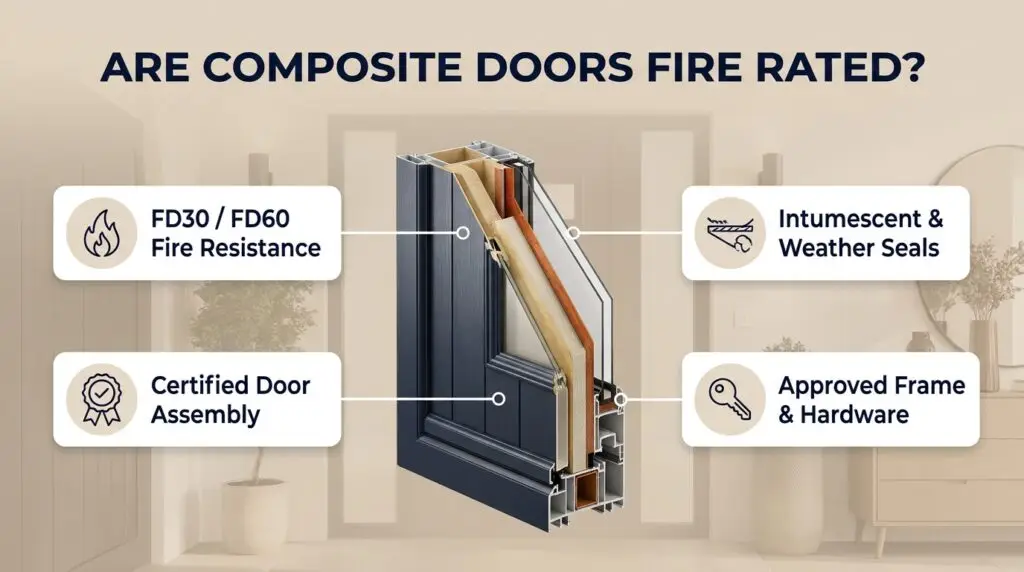
Composite doors are a popular choice for homeowners because they are strong, secure and provide good levels of insulation. However, if you’re thinking about fitting a composite door, you may be wondering whether they are fire rated and whether they can help protect your home in the event of a fire. So are composite doors fire rated? And what should you look when choosing one for your property?
What does fire rated mean?
A fire-rated door has been tested to determine how long it can resist fire and, depending on its classification, help prevent flames and hot gases from spreading between different areas of a building. Fire resistance is usually expressed in minutes. For example, an FD30 fire door is designed to provide around 30 minutes of fire resistance when correctly installed as part of a suitable door assembly. You may also come across FD60 doors, which are designed for a longer period of fire resistance.
However, a door’s fire rating does not mean it is completely fireproof. It means it has been tested to meet a particular fire-resistance standard under specified conditions.
Are all composite doors fire rated?
No, not all composite doors are fire rated.
Standard composite front doors are generally designed to provide security, weather resistance and thermal insulation. Although their construction may include several different materials, this does not automatically mean they have been tested or approved for fire resistance.
As a result, if you need a fire-rated composite door, you should choose a model that has been specifically tested and certified for that purpose. It’s also important to check that the complete door assembly meets the required specification. This can include the door leaf, frame, seals, hinges, locks and other fittings.
Where might you need a fire-rated composite door?
Fire doors are used in certain parts of buildings to help slow the spread of fire and smoke, allowing people more time to escape and helping protect escape routes.
In homes, fire doors are particularly relevant in certain layouts, such as flats where a door separates the home from a shared corridor or stairwell. Requirements depend on the building’s design and the applicable building regulations. For example, a flat entrance door may need to provide a specified level of fire resistance. In this situation, you should not assume that a standard composite front door will meet the requirement.
If you’re replacing a door in a flat, a converted property or another building where fire safety requirements apply, check with a suitably qualified professional or your building control authority before choosing a replacement.
How can you tell if a composite door is fire rated?
If you’re unsure whether a composite door has a fire rating, there are several things you can check.
- Look for certification. Ask the manufacturer or supplier for evidence that the exact door model has been tested and certified for fire resistance.
- Check the product specification. The documentation should state the door’s fire rating, where applicable, and explain which frame, seals and hardware must be used with it.
- Confirm the installation requirements. Even a certified fire door may not provide its intended protection if it is fitted incorrectly or used with unsuitable components.
- Don’t rely on appearance alone. A fire-rated composite door may look similar to a standard composite door, so its appearance is not a reliable way to identify its fire performance.
If the door is required for a particular fire-safety purpose, make sure the documentation matches that requirement before arranging installation.
Are fire-rated composite doors secure and energy efficient?
A fire-rated composite door can also provide security and insulation, but its performance will depend on the particular product.
Composite doors are made using a combination of materials, which can provide a strong and durable structure. Many models also include insulated cores and effective weather seals to help reduce draughts and heat loss. However, you should check the individual door’s security features and energy-performance information rather than assuming every fire-rated model offers the same benefits.
It’s also important to use compatible locks, handles, hinges and other fittings specified by the manufacturer. Changing components without checking their suitability could affect the door’s fire certification.
So, are composite doors fire rated?
Some composite doors are fire rated, but many standard models are not. The important thing is to choose a door that has been specifically tested and certified for the level of fire resistance your property requires.
Before buying a composite door, check its certification, confirm that the frame and fittings are included in the approved specification, and make sure it will be installed correctly.
If your door is required to meet building regulations or protect a designated escape route, always seek appropriate professional advice rather than relying on the door’s appearance or construction alone.